Updated July 2025

In 2022 I planted my first five varieties of basketry willows, from Willowglen Nursery. The owners were very helpful, and talked to me at length on the phone . Unfortunately, I planted them too far away from my main garden for the hose to reach, and in the midst of some really persistent fescue grass as well as perennial dogbane and Kansas’s enthusiastic wild sunflowers, and so it’s taken awhile for them to get established, but even with what I would consider extreme neglect, in the pretty harsh summer environment of NE Kansas, those 25 cuttings have grown into significant stools.
Each year since then, I have added new varieties, some of which have done a whole lot better than others, and some of which I like a whole lot better than others. The ones that grow the best are the ones that do and will get propagated the most. I got 50 cuttings from my first five Packing Twine plants in 2023, which made 50 more Packing Twine stools, and this year got over 400 cuttings from those. Nothing else did nearly so well. So that is going to be one of my major varieties. I love how it weaves also!
Personally, I think it’s silly to grow a gazillion different varieties, especially when so many of them are so similar to each other, but you can’t know which ones will be the best until you try them out. It’s not like Kansas is full of willow-growers who can advise me. But already I can tell people around here what has grown well for me, and share cuttings with folk who’d like to grow it for themselves.
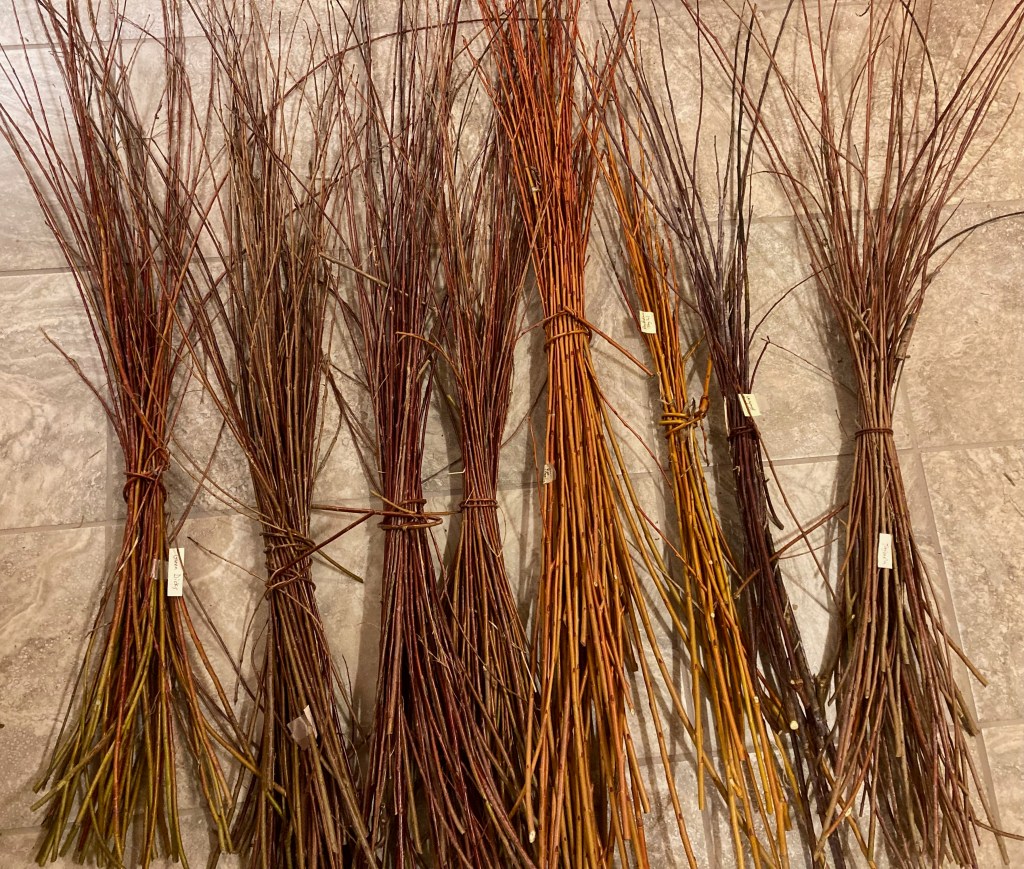
Here are the varieties I grow, and my early experiences with them:
PURPUREAS:
I had read that purpureas do very well in most of the United States, and that has absolutely been true for me. In fact, I would tell other folks in the central US that purpureas are the way to go if you want willow for basketry. Some of them have grown better than others, though. Other variables might be at play for initial variation–time of year cuttings are started (February plantings grow way more than April cuttings), fatter cuttings are stronger than skinnier cuttings, weed competition and water really matter, full sun all day really is better than half day sun, etc. But all in all, the purpureas are the willows that are happiest growing in our part of Kansas.
The purpureas seem very similar to each other, which makes sense, since they are all the same genus. Different varieties have been selected from individual plants that have characteristics that people like. Some named varieties might even be the same as other named varieties, as original names have been lost as people shared cuttings with other people.
Purpureas are not scary willows–they just want to be hedges. Maybe BIG hedges, but if you forget about them for a couple of years, they’re not going to tower over your fruit tree orchard, invade the pipes in your house, or shed limbs on your neighbor’s fencelines. I can appreciate that.
Americana: One of my original varieties from Willowglen in 2022. There seems to be some debate over whether this is its own genus (americana) or whether it is a purpurea. To me, it seems very similar to other purpureas. By its third year, even with not much water and pretty heavy weed competition, the stools developed with many tall, straight rods. I took cuttings the second year, and, starting them in February, they grew strong plants, even though the cuttings had been pretty skinny.
Bleu: Beautiful beautiful plants with dark rods and dark shiny leaves. I started these in 2024, and really look forward to expanding the planting of them. I haven’t had a chance to weave with them yet.
Dunbar Gardens reports that they make long slender rods, and Willowglen says that they can grow very big, with long, slender, straight and firm rods that are best when used for stakes in a basket, and that they dry a bluish, purplish dark grey. For me, they did grow fairly tall the first year (compared to other cuttings that I didn’t get into the ground until April), but not excessively so. Even with heavy mulching and regular watering, Kansas can be a pretty harsh environment in the summer. But the second year, yes–tall and still beautiful (though the grasshoppers seem to like them a lot)!
Brittany Green: I started cuttings from several different sources in 2025. They look pretty much like all the other purpureas, but they get the prize for being the best growing cuttings this year, for both the February and the April starts. Lots of rods and getting some height on them. Yea!!!!
Dark Dicks: This variety gets nice reviews from other growers, saying that the rods are long and large with dark red stems that dry to a deep purplish brown. For me, the first year (started in April 2024 with very skinny cuttings), they were short, skinny, and bushy/branchy. Starting them in April with not very big cuttings may have contributed to that. The second year they’re looking much better–tall, straight, and more prolific. I’m excited about how dark they are!
Dicky Meadows: This is supposed to be one of the standards of basket-making. I started with 5 cuttings in 2023. The first year, they produced very skinny lovely long slender rods, but not very many of them and many of them were branching. They were the color of dark red kidney beans. The second year they went nuts! They grew much better, much taller, and much thicker. I got over 100 good-sized cuttings for propagation. The tip ends I used last year were beautiful to weave with; I can imagine what a joy full rods will be.
Frances Red: They are reported to have long flexible unbranching rods, and to dry a beautiful gray with some purplish-red after soaking, and be a favorite weaver at Lakeshore Willows. Cuttings started in 2025 are growing great!
Goldstones: These are reported to dry a vibrant green, but I haven’t seen that yet; for me, they have been just gray. This is another variety that did really well in pretty adverse conditions. It was another ill-chosen location (away from the hose and sun only from 10:30 am until 6 pm), and this was the only one of those five varieties that really thrived. The 2023 Goldstones originals are still there, but the 2024 cuttings I took from the originals and planted in a better location did great.
Green Dicks: I was looking to order cuttings of these for 2025 when I realized that it was one of my original 2022 varieties. They were the puniest of those 5 (in terrible conditions), and 3 of the 6 original cuttings died the first year. But by the third year, they were looking great. Rods are prolific, straight, and slender. The bottom third of each rod is very green, and then they turn red farther up. I did some major expansion in 2025, where they were again slow getting started, but now that I know what they can do, I don’t mind.
Green Edna: This is a favorite of several basket weavers who sell cuttings, so I thought I’d give it a try. Starting with medium green cuttings, they produced the smallest growth of any of my 2024 cuttings. The plants were very short and very bushy, both the first and second years, and I’m not sure this variety is worth propagating in Kansas. But since our all-time favorite sheep was named Edna, I’ll do what I can to keep them going.
Harrison’s Brown: This is a purpurea x viminalis cross, that is supposed to make large rods which dry to a dark brown. It is purportedly a popular basketry willow that could also be good for fences and living willow structures. Mine gets really eaten up by bugs, so its growth has been really stunted even though it’s in a prime location. In 2025 I planted some cuttings of this in various other places, which are growing reasonably well.
Hutchinson’s Red: This is supposed to produce long slender rods. Mine were very short (like 1.5 feet) and bushy in 2023. I coppiced 4 out of the 5 and let one be. The next year the uncoppiced one stayed super-short and bushy, and the other four were a little less bushy, but still really really puny. And in its third year, all are still puny. Oh well…another one I won’t be propagating!!!
Irette: People on willow forums say that their Irettes grow really big. My first year cuttings did not, but perhaps that’s because they didn’t arrive until April, so they got a late start. Two of the five cuttings died, and the ones that didn’t die didn’t grow much, even with lots of watering and ample mulch. There were lots of little tiny branches coming off of them all up and down the rods. But in their second year, they are big and TALL. I will definitely propagate more of these! I hope they weave well.
Jagiellonka: For me, this was very similar to Dicky Meadows, with similar growing habits, except that whereas Dicky Meadows was the color of dark red kidney beans the first year, Jagionella was the color of light red kidney beans. It also did GREAT the second year, and I got over 100 good-sized cuttings from those 5 original plants.
Lambertiana: It’s supposed to grow long and narrow weavers that dry to a deeper blue/green/brown color that holds up after resoaking. Cuttings started in 2025 are growing reasonably well.
Leicestershire Dicks: Another purpurea that’s supposed to make slender rods, good for weaving. These were started in April (too late for Kansas!) with skinny cuttings. They grew reasonably well, with, yes, skinny rods. But there wasn’t much to take for cuttings for propagating, and in their second year, they are still puny, and oddly prostrate rather than upright.
Michigan Green: I got cuttings in 2024 from Willowbrook Basket Farm. They said it was originally discovered by Sandy Whalen in an old deserted willow patch in Michigan. Supposedly it dries in a variety of brown, gold and green with a good selection of tall and short rods. In their second year, they are growing long and sturdy rods. I wouldn’t be surprised if this was the same variety as Oka, because I sure can’t tell the two apart.
Oka: These 2024 cuttings also came from Willowbrook, who says that it’s an old French basketry willow that was found on the grounds of Oka Abbey, Quebec. They got it from Lakeshore Willows. Supposedly it dries a light brown and is great for all parts of basketmaking. It looks identical to Michigan Green, both in its first and its second years.
Packing Twine: This is my all-star variety. My 2023 cuttings grew like crazy, tall and prolific even the first year, way better than any other purpurea! The second year, those stools just got bigger, and my 50 new plants grew great too. Dried rods are a dark gray-green, and are lovely for weaving with.
Polish Purple: Started cuttings from several different sources in 2025. It’s supposed to be a very popular basket willow. They are all growing reasonably well, in both ideal and less-than-ideal locations.
Purpurea #187: Here’s the description from Vermont Willows: “A vigorous selection of purpurea originating from SUNY Syracuse in their search for biofuels. This originally wasn’t meant for public use, but legends say someone was seen fleeing their nursery with armfuls of cuttings! This, along with all purpurea, are deer resistant, and offer long, straight rods for weaving projects of all kinds. Ours produce multiple 8′ rods annually.” I got my cuttings from them in 2024, but unfortunately they got accidentally mowed down mid-summer (I guess I forgot where they were, so they got neither watered nor weeded and the grass was taller than they were). Somehow, four of the five managed to survive, and in their second year, they’re growing better, along with five new cuttings.
Streamco: There are reports that they make 60 rods/plant in 3rd year and have great tension for baskets. These can be ordered from many places for stream bank restoration projects. I ordered mine for 2025 from Under the Tree Farm. When they arrived, they were the wispiest of twigs, 12″ long but only 1/8″ in diameter (not really a size I would sell as cuttings). Fortunately, I’ve been able to keep them well watered, so they are growing, but (obviously) a whole lot less vigorously than the cuttings which are thicker.
Vermont Red: Started cuttings in April, and though they are growing, they are much smaller than the other varieties started in February. According to Vermont Willows, it is a purpurea that escaped into the wild and makes deep red-colored stems when grown in the full sun. It is reportedly shrubby instead of tall and slender, but produces lots of deep-red slender rods, which I imagine could be very useful as a color in baskets.
FRAGILIS:
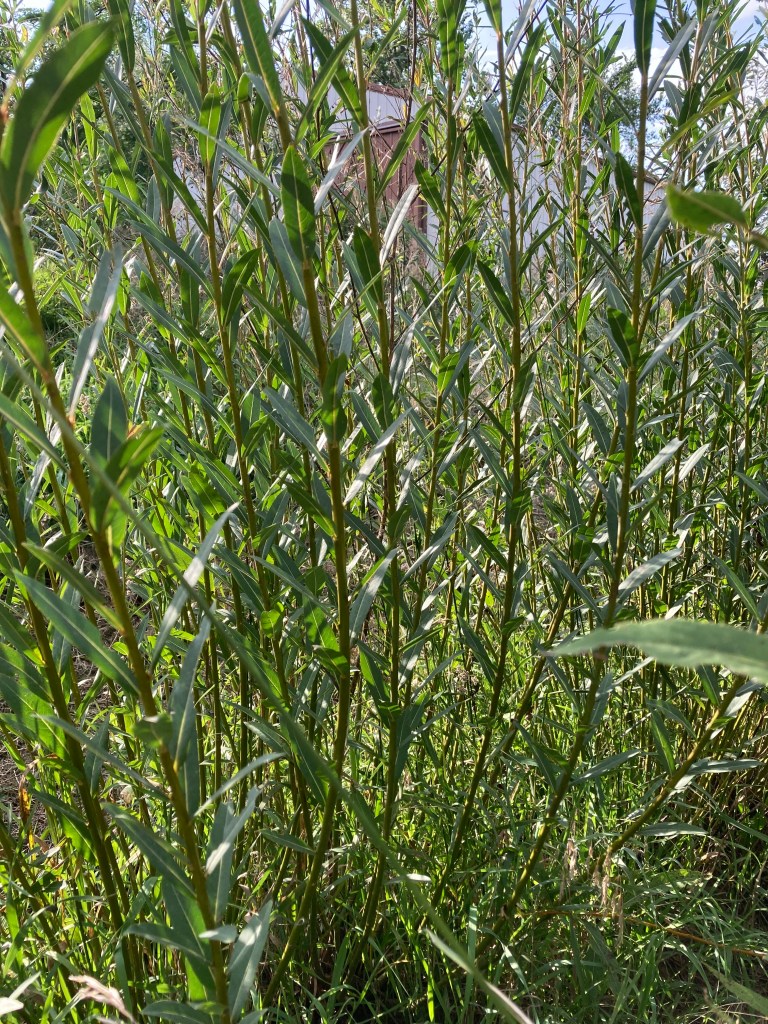
These seem pretty happy in Kansas. They grew like weeds, thick and tall, my first year. They want to be big trees!!! If you keep them coppiced every year, they should stay well-behaved.
Basfordiana: This is a fragilis x vitellina cross. It has a beautiful yellow-red color, a little more yellow than Natural Red. Like Natural Red, it is tall and thick with some branching, though not as many rods. Rods dry a warm yellow-brown.
Belgian Red: One of my original 2022 varieties, grown in adverse conditions, but by the third year, producing lots of tall, straight rods. They’re supposed to be between 7 and 10 feet; mine are between 3 and 6 feet. But in a better location, I’m hoping they’ll get taller. I’m going to do some major propagation in the spring. Remember, fragilis wants to be a big tree!
Jaune de Falaise: This is another fragilis x vitellina cross, reportedly with slender rods. Willamette Willows says that its nice for both basketry and landscaping with a vibrant yellow-orange color after leaves drop in the fall. All I can report is that it doesn’t do very well in adverse conditions–weed competition and almost no watering. Yet, it survived and made triple the number of rods the next year. We’ll see if it does better in better conditions.
Natural Red: Dunbar Gardens reports that it’s a nice weaver and that it dries a reddish brown. It has been the most vigorous of any of my cuttings, growing big and strong (and branching). I haven’t weaved with it yet, but I did harvest a bunch of bark for bark baskets. I put in a lot of cuttings in other, less advantagious places, and they didn’t do nearly so well. One patch is on top of an old farm dump pile, another in a row near some giant old willow trees that are probably sucking up all the moisture, and one on the far side of my vegetable garden where they get lost in weeds.
Raesfeld: Some sellers of cutting are calling this Alba and some are calling it Fragilis. It is reportedly a good basketry willow for medium to large work with nice, waxy yellow to green rods. My 2025 cuttings are growing reasonably well.
ACUTAFOLIA
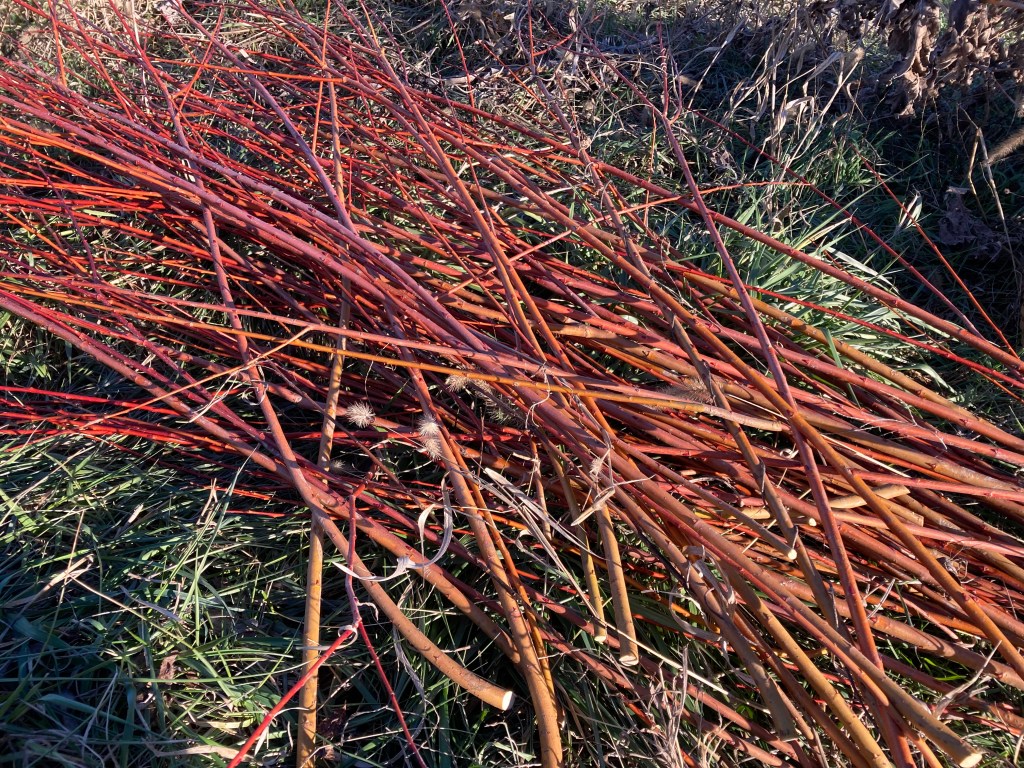
These aren’t supposed to do particularly well in our part of the world. Actually, they’re not supposed to be anywhere near as vigorous as the purpureas or fragilises anywhere, but they’re grown for the gorgeous colors of their rods.
Blue Streak: It is supposed to have a waxy white bloom on its bark that would make it good for accents in baskets. I hope to use the bark in bark baskets. My 2025 cuttings are puny, but alive.
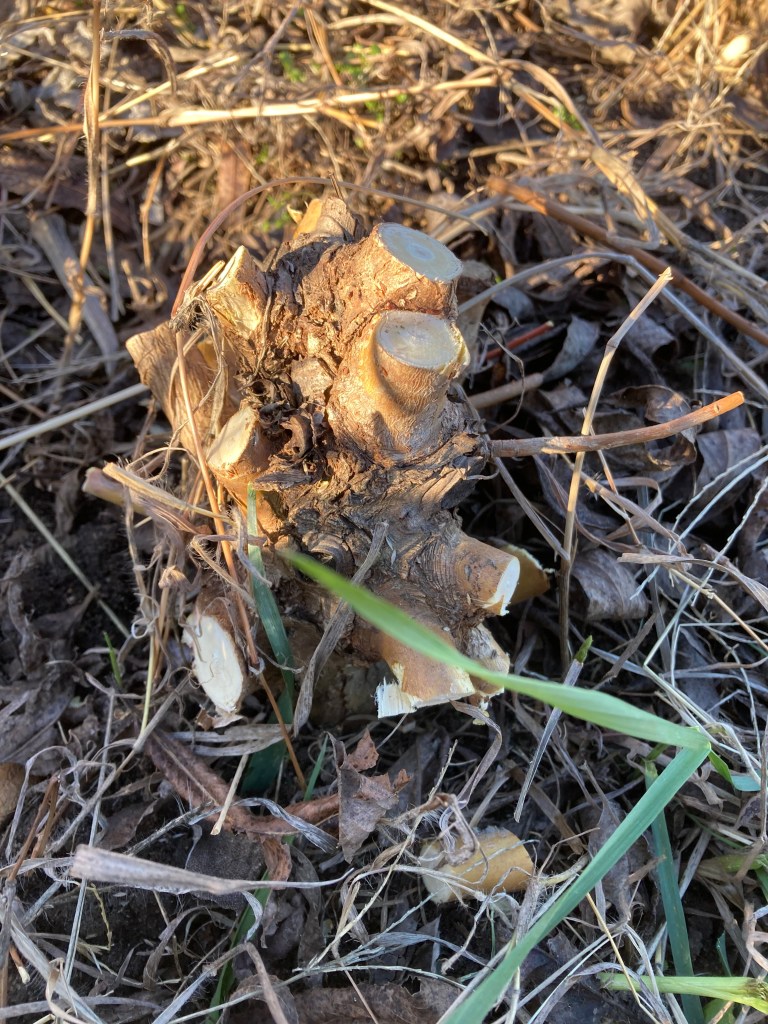
Unnamed Acutafolia: Started cuttings in 2023, and, as others have suggested, it doesn’t produce a lot of rods. But the second year plants are bigger than the first year plants, so I’ll keep them going. The rods were a dark purply red with white bloom that looked really interesting, especially for bark, though the rods were still pretty skinny. Too bad they were so bug-eaten in June and July. Japenese beetles love them! And then in December, the bottom half of each rod developed some kind of a black smut on it.
DAPHNOIDES:
This is the European violet willow, which can grow as either a large shrub or small tree, reaching a normal height of 25 – 30 feet. I haven’t had the best of luck with it.
Le Bleu: Completely died in 2023. Cuttings planted in a less-than-ideal location (where the Goldstones managed to grow anyway).
Overo Udine: Completely died in 2023. These cuttings were planted in a GOOD location, where everything else started there did fabulously. So, as wonderful as the description sounded, it just wasn’t happy in Kansas. You can’t argue with that. It’s so much easier to grow things that WANT to grow in your location!
Purpurea X Daphnoides: I got these from Willowglen in 2022, and they’re doing great. Long, sturdy, reddish rods. I will be propagating many more of these spring of 2025. It’s probably the purpurea part of this cross that is responsible for how well it’s doing.
RUBRA:
Another name for this is red osier, and it is supposedly a natural hybrid between salix purpurea (purple willow) and salix viminalis (common osier), and it’s supposed to produce straight, flexible rods good for making baskets. It wants to be a large shrub (up to 20 feet tall and wide), so it’s not a scary willow.
But it doesn’t seem to like Kansas. My only rubra, Harrison’s, died. Alas!
TRIANDRA:
This is one of the most popular basket-weaving willows in Great Britain and Europe. It isn’t supposed to grow well in most of the United States (with the exception perhaps of the Pacific Northwest), and, needless to say, it’s not very happy on my farm. I planted Black Maul cuttings in 2023. They survived, but just barely, their first two years. I was able to get a few cuttings that I could put in a better location, but honestly, why bother? There are so many other willows that WANT to grow.
ORNAMENTAL WILLOWS:
Blackskin: (myrsinifolia) I ordered cuttings for this for the color of the rods, but it doesn’t seem to like Kansas very much. Only one of the five cuttings is still alive the end of July, despite regularly watering and weeding.
Dart’s Snake: (Babylonica f. tortuous) This is supposed to be an olive green/brown curly willow. Great for wreaths and floral design. It will want to grow into a 30′ tree if not coppiced regularly. 2025 cuttings doing reasonably well.
Flame: (salix x ‘Flame’–ie, it seems no one know exactly what it is) It seems more like a fragilis to me, except a whole lot branchier than my other fragilis willows, but similarly vigorous and chunky. Here’s what Willowbrook says about it: “Stunning in the winter time when rods are bright orange/red. Fast growing and branchy but worth the effort to cut for basketry. Dries an orange/yellow. Rods should grow without branching in subsequent years. Used primarily as weaver for brilliant color accents.” Yes, my 2024 cuttings were fast-growing and branchy, and yes, the color was gorgeous. Equally branchy the second year, but they’re planted close together, and I’m happy to see what it does. Maybe the third year will be the charm. I can always appreciate vigorous growers!
Mt. Aso: (gracilistyla) Also called Japanese Pink willow, it is a lower-growing shrub that produces fuzzy pink pussywillow catkins that can be used in flower arrangements. Cuttings from 2025 barely growing. I wonder if they hate Kansas.
Rabbit’s Foot: (leucopithecia) This is a giant pussywillow with huge silver catkins that are said to resemble rabbit paws. It is a close cousin to Winter Glory. Cuttings from 2025 are very puny, as are the Winter Glory ones.
Really Red: (x erythroflexuosa) Willamette Willows says that this is their reddest curly willow. Cuttings from 2025 growing reasonably well, and they are really red.
Rubikins: (koriyanagi) I ordered this to be a basket willow, but evidently it’s not that easy to weave with, and may be better as a landscape specimen. It is supposed to have slender, non-branching rods up to 10′, and produce small, pinkish gray pussy willow catkins. I’m afraid I may have lost them amongst the weeds. Note to myself: Do not plant willow cuttings anywhere unless you have thoroughly prepped the area!
Sunny Twists: (pendulina f erythroflesuosa) Yellow branches turn orange-red when leaves drop in fall. This one is really curly, and really fun to cut and put in a vase inside for great winter arrangements. I don’t have enough cuttings for all my friends that want to grow their own.
Winter Glory: (leucopithecia x) Willamette Willows says that it is a very large pussywillow that produces beautiful dark red buds that erupt into large, fuzzy, silver catkins. It is their earliest blooming pussy willow, and it has red buds that are followed by silver catkins. Cuttings from 2025 barely growing.
WILD WILLOW
No clue what the giant willow trees behind the shop and along the fenceline are. They drop branches all the time. We’ve been hacking at the ones behind the shop because we don’t want them to destroy the shop roof. The subsequent year rods are weavable, but a bit brittle.
Another wild willow is the scrubby stuff that grows around the pond. I haven’t tried cutting it and seeing how it regrows yet, but I probably will.
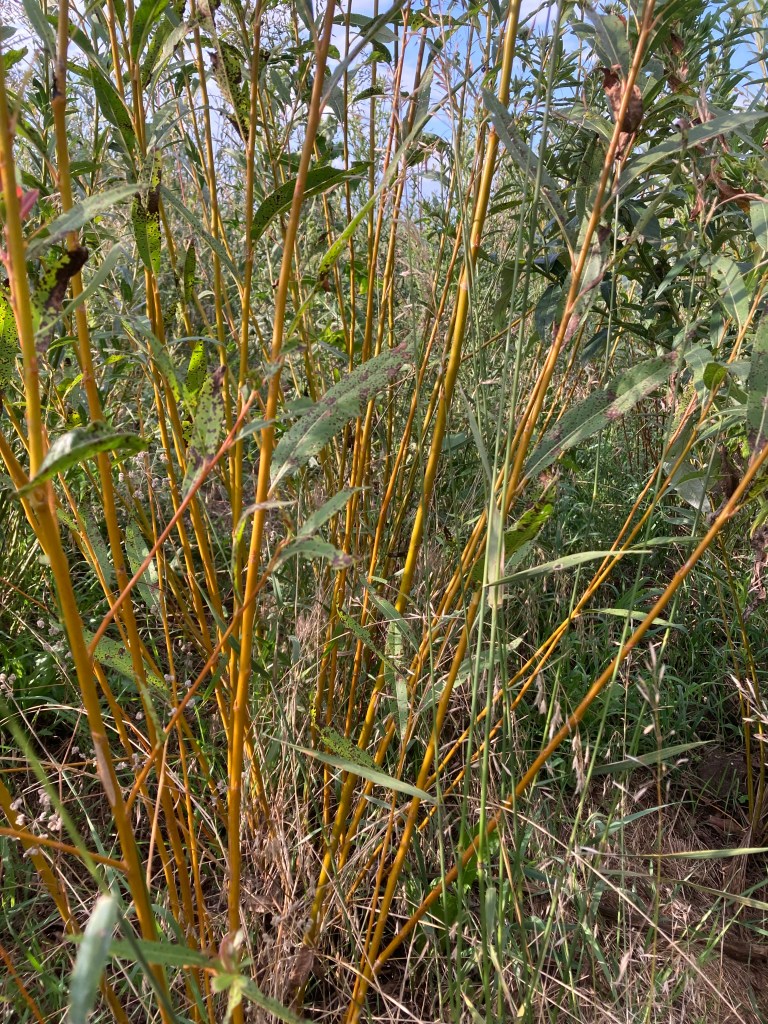
 Fig Hill Farm & the Kansas Figgery