(Updated July 2025)
Pears are said to be better suited for growing in NE Kansas than apples. We’ve grown both (in town) with similar results, and so far, both the apples and pear trees on the farm are growing about the same.
In 2023, we had one single apple and one single pear. In 2024, none. In 2025 one pear tree is making about a dozen fruit. Can’t wait for real production to start. It would probably help if we had mulched our trees and watered them; they would have grown a whole lot faster. Alas.
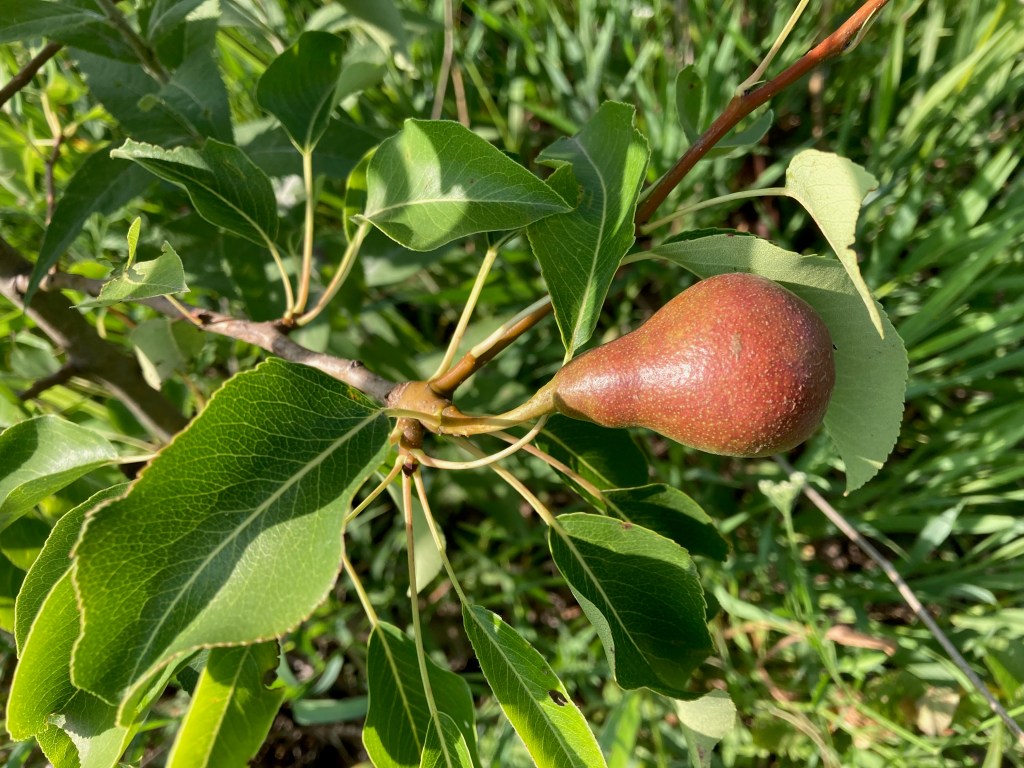
These are the varieties we are growing. All of the pears that we are growing are supposed to be highly disease-resistant, especially to fire blight, which is the one disease we have lost pear trees to in town.
Aurora: This is one of the few pears that has a spreading rather than upright form. It’s supposed to be an exceptionally flavored dessert pear–sweet and aromatic–juicy with smooth flesh.
Bell: From Adam’s County Nursery, and supposed to have ranked “highest in flavor intensity, flavor balance and juiciness among other pears” in all their trials. We’ll see. It’s taking a long time to get going. It didn’t help that the root hairs dried out in the sun before we got it to plant it in 2022. This year, in 2025, is really the first year it’s put on any real growth.
Butt: This is supposed to be a good perry pear–terrible for eating out of hand, but producing an astringent and fruity juice that makes a great cider. It is, unfortunately, a very slow-growing tree (as we have observed ourselves), and is reported to tend towards biennial fruiting, but evidently the fruits can sit on the ground without rotting. Cummins nursery says that this pear gets its name from the saying: “Gather your Butts one year, mill them the next, and drink the year after.”
Comice: This is a determinedly upright tree that resists any attempts to make it spread. It will die rather than grow anything horizontally, so beware! Our comice tree in town only flourished once we let it grow the way it wanted to grow. It makes good tasting pears.
Harrow Sweet: Originally from Ontario, with Bartlett and Old Home x Early Sweet as parents, this pear is supposed to be a heavy-cropping late pear which is delicious, disease-resistant, and a good keeper.
Hendre Huffcap: This is supposed to be a perry pear–terrible for eating out of hand, but its light, high-quality juice, low in tannin, is supposed to ferment into a delicious pear-cider. The name (presumably) comes from the idea of a beverage so strong that it “huffs” your cap up off your head. In 2025, it finally shot up some real growth (but still no pears).
Honeysweet: Supposed to be a spreading and precocious tree, bearing young (at 5 – 6 years). Its fruit is said to strongly resemble Seckel, which is one of its parents: rich, spiced, aromatic, and as sweet as honey.
“Kasold” Perry Pear-A spitter, for sure, but we’re thinking it might be good for making perry. Scion from a huge pear tree on Kasold, which must be at least 70 years old.
Kieffer: The classic canning pear which can be found on countless old farmsteads. There are a lot of old Kieffers around town, pumping out gritty pears year after year, but there’s certainly something to be said for their hardiness.
Magness: An aromatic dessert pear. It is sterile, so won’t pollinate other pears. Reportedly, it is slow to produce.
“Missouri Street”: An Asian-type pear we discovered growing on Missouri Street in Lawrence KS with super-intense complex flavor. Maybe someday we’ll be able to figure out what it is. The original tree is getting shaded out by mature street trees, so it’s not producing much anymore, but our young tree in the orchard is growing great. In 2025 it really shot up to be the biggest tree in the orchard, and perhaps it will make pears next year.
Olympic Giant: So far this has been one of our strongest growing pear trees. It’s a late pear, ripening in October, and makes huge fruits that can weigh as much as a pound. It’s supposed to store for up to five months (though we’ve never had the opportunity to test that, as we’ve never had more than we can eat.) In 2025, it made its first three pears–YEAH!!!
Orcas: This pear is supposed to have a vigorous, spreading habit and bear prolifically every year. It’s a late-bloomer.
Seckel: Super-sweet, aromatic fruit absolutely delicious for making the absolute best pear butter!
“Scott’s Mystery”: Another super-intense, complex-flavored Asian pear. It was probably planted in the late 80s. This is our absolute favorite pear–it’s great for fresh eating and for drying. We do need to figure out what variety this actually is. What Asian pears were popular to plant in the 80s?
Shenandoah: This is supposed to be an upright-spreading tree that starts producing after three years (not here, not yet, and it’s been five years). Supposedly its fruit is sweet, aromatic, and juicy, with a bit of acid, and will store for about four months.
Shinseiki: An early season, self-fertile pear, bearing heavy loads of small, round, sweet fruits that are supposed to hang on the tree for a long time (we wouldn’t know because in town they are squirrel-candy and some years we don’t get any at all because they squirrels make off with them before we even know that they’re ripe.)
Shinko: Another Asian pear we haven’t gotten to try yet, but it’s supposed to be large, round, russeted, with yellow-white crisp and juicy flesh and a distinctively rich, sweet flavor. And then keeping for three to four months. We shall see.
Shipova and Baby Shipova: These are crosses between European pears and Mountain Ashes from Yugoslavia. Why? Why not! Raintree Nursery says of the fruit: “When fully ripe, the slick, sweet flesh has a hint of tropical guava or mango to it; as it ages the texture softens and the flavor builds to a rich marzipan!” But alas, they are both dead, the Baby Shipova the first year and the Shipova two years later.
Sunrise: Another pear from Adams County Nursery, this one has been spreading from the beginning. Supposed to be a good keeper. It also had a rough beginning like Bell, and has barely grown at all, even three years later.
Tsi Li: The other Asian pear tree we grew in town, which did NOT succumb to fire blight the bad fire blight year. Fruit similar to Ya Li but more acidic and more strongly flavored.
Warren: Reportedly one of the best pears for pollinating other European pears. The fruit is said to be sweet, spicy and very juicy, buttery, silky flesh with no grit. Many people compare Warren’s flavor to Magness.
Ya Li: This has been Theresa’s favorite Asian pear. The fruits are large, crispy, juicy, with not much flavor, which (for her) makes very pleasant eating. Keeps through April. The Ya Li tree in town made bushels of fruit every year, but unfortunately succumbed to fire blight one very bad fire blight year (even though it’s supposed to be highly resistant to it). The in-town pear trees did not have much air circulation, which probably didn’t help.

 Fig Hill Farm & the Kansas Figgery